

Construction is one of the most physically demanding industries in the country. Whether it’s electricians wiring a building, roofers working at heights, or general contractors managing busy job sites, the work involves real risk. Because of the on-the-job risks involved, Workers’ Compensation insurance is one of the most important protections a contractor can have, both for employees and for the business itself.
Workers’ Compensation coverage ensures that when workplace injuries and illnesses occur, employees receive the care and financial support they need, while contractors gain protection from costly claims and legal exposure.
What Is Workers’ Compensation Insurance?
Workers’ Compensation insurance provides benefits to employees who are injured or become ill as a result of their job. In most states, any business with employees is legally required to carry Workers’ Compensation Insurance. The rules vary slightly by state, but the objective is to ensure that workers have a reliable system for receiving medical treatment and wage replacement if they are injured on the job.
Instead of filing a lawsuit against their employer, injured workers file a Workers’ Compensation claim. The insurance policy then pays for eligible benefits based on state regulations.
How Workers’ Compensation Protects Employers
Workers’ Compensation offers significant protection for contractors and business owners. It helps limit legal exposure. In most cases, Workers’ Compensation benefits serve as the employee’s exclusive remedy for workplace injuries. This means employees generally cannot sue their employer for damages related to the injury.
Workers’ Comp also helps contractors manage financial risk. Without insurance, the cost of medical care, lost wages, and legal fees could easily overwhelm a small contracting business.
Workers’ Compensation also helps contractors:
- Demonstrate professionalism and financial responsibility
- Meet contractual requirements for project bids
- Protect business assets from large claims
- Maintain compliance with state labor laws
How Workers’ Compensation Protects Employees
Construction workers face a variety of hazards every day, from heavy equipment and electrical exposure to falls and repetitive-motion injuries. Workers’ Compensation ensures employees have financial and medical support if something goes wrong. Typical Workers’ Compensation benefits include:
- Medical Care: If an employee is injured on the job, Workers’ Compensation pays for medical treatment related to the injury. This can include doctor visits, hospital stays, surgery, rehabilitation, and medication.
- Wage Replacement: When injuries prevent employees from working, Workers’ Comp typically provides partial wage replacement while they recover.
- Disability Benefits: If a worker suffers a long-term or permanent injury, additional benefits may be provided depending on the severity of the condition.
- Vocational Rehabilitation: In some cases, injured workers may receive training or assistance to help them return to work in a different role.
- Death Benefits: If a workplace accident results in a fatality, Workers’ Compensation can provide financial support to the employee’s dependents.
For employees, these protections provide peace of mind that they will not face overwhelming financial hardship after a workplace injury.
How Workers’ Compensation Premiums Are Calculated
Premiums for Workers’ Compensation insurance are primarily based on three factors:
- Payroll: The more employees and wages a business has, the greater the potential exposure to workplace injuries. Insurance companies typically calculate premiums as a rate per $100 of payroll. For example, if a rate is $10 per $100 of payroll and a contractor has $100,000 in payroll for that classification, the estimated premium would be $10,000.
- Job Classifications: Not all construction work carries the same level of risk. Because of this, each type of work is assigned a classification code. For example, roofing typically has a higher risk classification than other types of work; office employees are classified separately from field workers. Each classification has its own rate based on historical injury data for that type of work.
- Experience Modification Factor (X-mod): The X-mod adjusts a company’s premium based on its past claims history.
- A lower X-mod (below 1.0) means fewer or less severe claims and may reduce premiums.
- A higher X-mod (above 1.0) indicates higher claim frequency or severity and may increase premiums.
Contractors with strong safety programs and fewer claims often benefit from a better X-mod, which can help keep insurance costs down over time.
Workers’ Compensation Solutions for Contractors Through CCIS
Navigating Workers’ Compensation requirements can be challenging for contractors, especially as job sizes change, subcontractors evolve, and workforce needs shift. CCIS specializes in helping contractors in Arizona, California, Nevada, Oregon, and Washington State secure the Workers’ Compensation coverage they need to operate confidently and remain compliant with state regulations.
Whether you employ a growing team of tradespeople or are working toward expanding your business, CCIS works with contractors to place coverage that fits the scope of their operations.
In addition to traditional Workers’ Compensation policies, CCIS can also assist contractors who do not currently have employees but still need proof of coverage. A Ghost Policy is a Workers’ Compensation policy issued to a contractor with no employees and no payroll. It does not provide employee injury coverage but serves as proof of Workers’ Compensation coverage for contractual or licensing requirements.
Protecting Your Workforce and Your Business
For contractors, Workers’ Compensation insurance is a critical layer of protection that supports employees, safeguards businesses, and keeps projects moving forward after unexpected incidents. With the right coverage in place, contractors can focus on what they do best: new commercial and residential builds, renovations and repairs, and maintaining the infrastructure that keeps communities running.
Contact CCIS for a free quote.
Protect Yourself
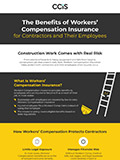
Download our comprehensive infographic to learn how Workers' Comp protects your employees' health and wages while significantly reducing your legal exposure and financial risk.
*NOTE: The insuring agreement in a policy sets out the covered perils, assumed risks, and nature of coverage that the insurance company provides to its insured in exchange for the premiums paid. Thus, the terms and conditions of the policy will dictate whether coverage exists and the nature of any potential benefits.